Showing posts with label Asia. Show all posts

Thursday, April 28, 2011

Roger McDonald


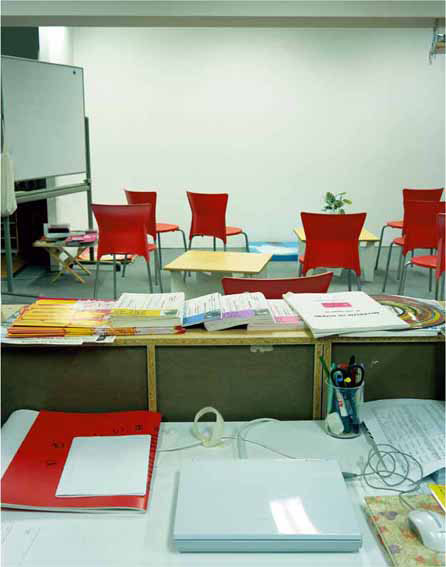
As to prepare the Work Space series for Other Possible Worlds in NGBK, I had to update the info of the art spaces that I visited for the project 3 years ago and re-read the original text. The one provided by Roger McDonald of AIT also includes a written reply to my questions drafted for the interview. It still reads well and I share it here.

What’s the name of your organization?
Arts Initiative Tokyo or AIT for short.

Where, when and who founded it?
Began MAD, our school in 2001. Became a registered non profit organization in 2002.

What’s the story behind this name?
It says most succinctly what we do and what we aim to do – create initiatives related to art from Tokyo.

How many people were involved when it began and how many now? Who were/are they?
Six people at the start. Three of us are full time. Four work in other positions and plug in when necessary.

How did it start? What was the social/cultural background then?
Talking over beers in bars about what we thought Tokyo lacked/ needed/could do with improving. Many of us had spent time outside Japan studying. We had all returned to live and work. We began by spending about six months talking to various people, doing research and field work on what the Tokyo art situation was like – mapping it out to see what may be needed and how things could be different/ better.

Did the location of your first space matter? Did you ever move? Why/ why not?
For the first 2 years we ‘squatted’ the library/ meeting room of Nanjo & Associates curatorial offices. We moved into our current premises in 2004. We have remained in the Daikanyama area of Tokyo because it is near Shibuya (a major train hub), has a certain village feel about it and seems attractive to the people who sign up for our courses.

What was the management model in the beginning? Any change in the structure of organization? Why/ why not? Are you steering it to an unprecedented model, or you do have some examples as reference?
Director, two Deputy Directors. Practically speaking we each do multiple things. Each project may be led by one member with assistance from the others. Finances and general strategy is co-ordinated by the Director. Its rather shared and equal. Being small, we have tried to keep things compact, sustainable and tight.

What kind of activities did you do in early years and what’s the change and development? How do you see the relationship between your change and the development of local art scene?
The first initiative was MAD, our school. It is independent of academic institutions and works more like evening classes. We offer Japan’s first curatorial studies courses, as well as courses on reading texts in English, contemporary art history and artists presentation skills – all aspects which art schools seem rather weak at. We began the artist in residence in 2003 because Tokyo lacked a proper residency – the city or state was not interested. Our efforts have hopefully encouraged others to follow suit, and now the City of Tokyo operates a residency. We continue to curate experimental exhibitions and events, and organize artists and curators talks. If someone interesting is passing through Tokyo we can organize something fast, without bureaucratic paper work. There is a large, eager constituency for contemporary art in Tokyo and beyond, which we try to tap into and expand. We are interested in creating discursive, layered spaces, rather than privilege exhibition or display.

How do you position your institution in relation with other establishments, organizations and artists in the hierarchy (if any) of the art world?
We try to read and map the situation, to see what could be improved and maintain an independent attitude. Being an independent school offers a sense of difference to being a gallery or museum or art university. We seem to attract many people who want to learn more about art, but who are not students. Working people, house-wives, businessmen and students seem to be able to connect with what we offer and do – perhaps because we are not a ‘traditional’ framework like a commercial gallery or museum. This sense of broad appeal and molding a space wherein people can come together to think and discuss art and related issues at length is important to us.

What’s the focus of your programme? Do you specialize in certain area of art & artists? Are you also engaged in international/regional exchange? Could you elaborate your ideas on this issue?
Our main initiative is running a school, and all this entails. We invite speakers from different fields to come and speak, we put together curriculums and try to create a comfortable space to discuss issues related to art, society, politics, religion. We do have a particular penchant for thinking about contemporary art as one activity within the wider social field, so we are interested in relations between what artists do and the various ways we can understand this. We try to maintain an international outlook – all our public mailings are bi-lingual and talks are consecutively translated. Many foreign curators and artists come to visit us. But this is time-consuming and often expensive. I notice that in recent years the subject of education or learning and contemporary art has received a fair bit of attention. I like to think that since 2001 we have tried to practice and initiate another way that an arts organization can operate. We are interested in nurturing audiences for contemporary art in Japan, and so are very open to offering courses which take an introductory or beginner’s level approach, right up to post-graduate level sessions on art theory or aesthetics. We are also interested in thinking how larger theoretical concerns such as ‘post-colonialism’ or ‘globalisation’ can be thought through in Japan – to connect them to local histories and issues rather than simply being exotic concepts which are expounded in big exhibitions in Europe. I suppose you can say that we are constantly involved in processes of translation and mis-understanding. It seems that this kind of experience is something that cannot be so easily generated in commercial galleries or even museum shows which tend to be about explicating clear narratives and understandings. I hope that what MAD enables is some space for dissonance and un-learning to occur – to be able to question what canons have passed down, to think imaginatively.

Where is your funding from? Is it related, or does it affect your programme? How do you see commercial sponsorship? How do you maintain your independence in programming?
Amost all of our funding is self generated – we developed a business model from the beginning and this has continued. The school generates most of our annual income. The courses are fee paying and of different duration. The artist in residency generates income through management fees from various foreign arts partners, like IASPIS, FRAME and Asialink. Project funding is generated from individual grant applications to Japanese Foundations. In these cases, the content of projects may be broadly tuned into the particular directions of Foundations or Companies. But basically we are rather independent in terms of funding. We must generate our salaries, running costs, rent etc by ourselves.

Is there any legacy in your organization?
We are in our eighth year. I hope that some legacy may begin to emerge after ten years or so.

What are the weak point and the strength of your organizations?
Weaknesses – we tend to be rather ‘invisible’, because much of what we do involves discursive events rather than exhibitions. Strengths – Our ‘invisibility’ enables us to remain focused on issues and nurture longer durational projects or interests.

Has it ever have any crisis? How did it get over it?
When visitors enter our space without taking their shoes off – we ask them politely to do so and all is well.

What’s your plan/idea/dream for the next five years (shorter or longer)?
To develop new layers to what we have built up so far – to create a more complex and self generating situation which continues to build on what we have achieved. Small steps, to slowly generate new potentials – e.g. AIT book publications series, work with artists to realize limited editions, create a small exhibition area in our classroom space etc.

Wednesday, February 24, 2010

She was lost in the past and we found her today.


Site-specific installation (conceptual illustration above) by Leung Chi Wo & Sara Wong, vinyl sticker on glass, Yaguchinowatashi Station, Tamagawa Line, Tokyo, 2010

Shopping street at Yaguchinowatashi (right next to the station), Tokyo, 1955

Opening programme, Tamagawa Art Line Project 2010

Wednesday, January 20, 2010

Chen Shun-chu 陳順築


It was a time the artistic practice of Taiwanese artists was such a good reference for me. Perhaps it was the hit time when everybody was talking about cultural identity. And Chen Shun-chu's work was always cited. My vague memory recalls someone had even said this was the Taiwan's answer to Boltanski. Above all, I really like his work. 14 years ago when I for the first time visited Taipei, I got his contacts from perhaps IT Park. And he did show up and chatted with us. Back then I was only a student and you already saw his work featured in international magazine. Then you could imagine his generosity and openness to others. He was very gentle, somehow you might like to relate to his work. I also remember his work in the exhibition Inside Out (curated by Gao Minglu) of predominantly mainland Chinese artists in the Hong Kong Museum of Art. From the first glance at his work, you could a;ready tell he's no mainland Chinese artist!
He also did a solo show in Hong Kong almost ten years ago. It was a beautiful exhibition but not very well attended unfortunately. Was it the indifference of our community then? Not sure, but if it's yes, perhaps it's also our indifference in general to contemporary art.
Anyway, this time it shouldn't be missed!

Monday, September 7, 2009

Emil Goh

Just got a sad news from Wendy Gan about Malaysian Chinese artist Emil Goh:
"Emil passed away suddenly on the morning of 7 September 2009 in Seoul. He had a seizure of some kind in the morning. The ambulance was called but his heart had stopped beating by the time the ambulance reached the hospital. His girlfriend was by his side.
This has been a huge shock. He was still young and with no health problems that we knew of. We do not yet know what exactly happened.
I hope you will remember him for the enthusiastic foodie and wonderful artist and designer that he was. He had a keen eye for the mundane but quirky beauty of small things and his vision, his sense of humour and his mind that bubbled over with intellectual curiosity and delight in the world will be sorely missed by all of us."


Our last meal in Seoul when I was there in 2008. Emil sitting behind the Korean bbq.

Friday, July 17, 2009

Podcast with Davide Quadrio

Davide Quadrio, also known as Dadou in China, speaks about BizArt, an independent art organization that he co-founded eleven years ago, and his experience in China. It's an interview made on March 13, 2008 when the commercial development of Chinese art was still burning hot. English, 50 min. Listen

Wednesday, May 13, 2009

Tuesday, May 12, 2009

Podcast with Zoe Butt

Slowly catching up with all those interviews that I did last year, I upload here the one with Zoe Butt, Director of International Programs at Long March Project conducted on March 14, 2008. She talks about generally Long March Project and her rather new position back then. Possible changes of Long March Project are also mentioned in it, now somehow as a note to the recent closure of its two of three galleries. English, 52 min. Zoe also co-curated Time Ligaments, opening this Sat, May 16, 2009 at 10 Chancery Lane Gallery Art Projects in Chai Wan. Listen

Cemeti closing

Surprise but not surprising! Cemeti Art House will be closed this summer. We talked about that a year ago in an interview.

Thursday, April 9, 2009

Rich. Streitmatter-Tran

International Curators’ Talk Series
Public Lecture -
“Curatorial engagements in the Mekong Subregion of the Southeast Asia”
by Rich. Streitmatter-Tran

Date: Friday 17 April, 2009
Time: 7:30pm
Venue: Room C01, Hong Kong Arts Development Council, 14/F, East Warwick
House, Taikoo Place, 979 King's Road, Hong Kong.
Seats: Limited Seats: 60

Para/Site Art Space is honored to present a Public Lecture by Rich.
Streitmatter-Tran, Co-curator of Asia Pacific Triennial (APT6).

Streitmatter-Tran is going to introduce some of the conditions in the
Mekong sub region that affect contemporary arts practices with a particular
stress on the curator-artist relationship. He will draw upon his previous
research with the Mediating the Mekong Project, which is a connection to
his current curatorial research with the development of a Mekong-based
platform for the upcoming Asia Pacific Triennale. He will attempt to
provide some insight from the perspective of an artist working with
curators and what an artist might consider a “good curator” as opposed
to an art critic, institution, and the public at large.

Rich. Streitmatter-Tran is an artist living and working in Ho Chi Minh
City, Vietnam. He received his degree in the Studio for Interrelated Media
(SIM) at the Massachusetts College of Art in Boston. His work, solo and
collaborative, has been exhibited in several cities in the United States,
Europe and Asia including the 52nd Venice Biennale, 2007 Shenzhen and Hong
Kong Bi-City Biennale of Urbanism and Architecture, the Singapore Biennale
2006 and 2008, the 2004 Gwangju Biennale, 2005 Pocheon Asian Art Festival,
ZKM in Karlsruhe, Germany, Asia Art Now at Arario Beijing, the Hugh Lane
Gallery in Dublin, Kandada Art Space in Tokyo, the Blue Space Gallery in Ho
Chi Minh City, the Asiatopia Performance Art Festival in Bangkok, Art Tech
Media 06 in Barcelona. He is an Asia Pacific correspondent for the
Madrid-based arts magazine Art.Es and Ho Chi Minh City editor for
Contemporary. He was awarded the 2005 Martell Contemporary Asian Art
Research Grant in 2005 with the Asia Art Archive in Hong Kong for his
year-long research project, Mediating the Mekong. He was Teaching Fellow at
Harvard University (2000-2004), conducted media arts research at the MIT
Media Lab (2000), Visiting Lecturer at the Ho Chi Minh Fine Arts University
in 2003. Currently he is a lecturer at RMIT University Vietnam and serves
as academic advisor to MOCA China and the co-curator of Asia Pacific
Triennial (APT6).

Para/Site Art Space
G/F, 4 Po Yan Street, Sheung Wan Hong Kong
Hours: Wed-Sun; 12-7
Tel: (+852) 25174620 │Fax: (+852) 25176850
info@para-site.org.hk
www.para-site.org.hk


藝術講座:國際策展人講座系列
公開講座
「東南亞湄公河屬區的策展空間」﹣RICH.
STREITMATTER-TRAN主講

日期:二零零九年四月十七日 (星期五)
時間:下午七時半
地點:香港英皇道979號太古坊和域大廈東翼14樓香港藝術發展局C01室
座位:60

Para/Site
藝術空間將於四月十七日,於香港藝術發展局舉辦公開講座;講者為Asia
Pacific Triennial (APT6) 聯合策展人﹣Rich. Streitmatter-Tran。

Rich.
Streitmatter-Tran將為大家介紹一些湄公河屬區影響當地的當代藝術發展狀況,
尤以策展人跟藝術家之間的關係。講者將講述其早前的研究計劃﹣「Mediating
the Mekong Project 」。這研究計劃跟講者現時為來屆Asia
Pacific Triennale
(APT6)而準備的策展研究計劃相連,是以湄公河屬區為發展平台的策展研究。
講者會嘗試以藝術家角度,表達藝術家跟策展人合作的一些觀點,
並對藝術家可擔當優秀策展人這舉措提供跟藝評、機構及公眾以外的看法。

Streitmatter-Tran現於越南胡志明市工作及居住,講者於波士頓Massachusetts
College of Art 的 Studio for Interrelated Media (SIM)
完成學士課程.。講者的個人及合作作品於不同城市如美國、歐洲及亞洲包括第五十二屆威尼斯雙年展、
二○○七年香港﹣深圳城市/建築雙年展、二○○六及二○○八年的新加坡雙年展、二○○四韓國光州雙年展、
二○○五年Pocheon Asian Art
Festival、德國卡爾斯魯厄的ZKM、Arario Beijing 的
Asia Art Now、都柏林的Hugh Lane Gallery、東京的Kandada Art
Space、
胡志明市的 Blue Space Gallery、曼谷的Asiatopia Performance
Art Festival、巴塞隆那的 Art Tech Media 06等展覽。Rich.
Streitmatter-Tran是西班牙馬德里藝術雜誌Art.Es的亞太區的特派員,
Contemporary的胡志明市編輯。講者與亞洲藝術文獻庫的研究計劃「Mediating the
Mekong」於二○○五年獲得Martell Contemporary
Asian Art Research Grant。講者是二○○○至二○○四年哈佛大學MIT Media Lab
(2000)的媒體藝術研究教學助理,二○○三年Ho Chi Minh Fine Arts
University的客席講師。講者現於RMIT University Vietnam任職講師、MOCA
China的學術顧問及Asia Pacific Triennial(APT6) 聯合策展人。

Para/Site 藝術空間
香港上環普仁街四號地下
開放時間:星期三至星期日;下午十二時至七時
電話:(+852) 25174620 │ 傳真:(+852) 25176850
info@para-site.org.hk
www.para-site.org.hk

Friday, April 3, 2009

Michael Lee


(photo by Qinyi Lim)
Singaporean artist Michael Lee Hong-hwee was based in Hong Kong for the last 30 months and has just bidded farewell to his first loft-studio in Fo Tan and moved back to Singapore. He talks about his artistic practice and Hong Kong experience. English, 53 min.
Listen

Wednesday, March 11, 2009

Jakarta Biennale


The Hong Kong Biennial somehow claimed itself as one of earliest biennales in Asia. Its first chaper was held in 1970s but nothing has been really changed as its nature as a local art contest. In spite of many expectations in the Hong Kong arts community, it made its "big" step simply to change its title to "Hong Kong Contemporary Art Biennial Award".

The first Jakarta Biennale was held in 1968 with a different title. It also takes it ages to evolve. Finally it went international this year. And Ade Darmanwen is the artistic director.

ruangrupa

"ruang rupa" means "visual space" in Indonesian. On Feb 17, 2008, I visited the artist-run space ruangrupa in Jakarta for the first time and saw a huge residential house-turned art space, a dog, some friends and artists. In this podcast, Ade Darmawan, Indra Ameng & Reza 'asung' Afisina talk about the organization, programming and development of ruangrupa. 75 min., English. Listen

Wednesday, March 4, 2009

Thank You Art


The Day of 39@rt ("thank you art") is a holiday to appreciate, promote, and otherwise positively engage ourselves in contemporary art. It was established by Japanese artist Yoshiaki Kaihatsu in 2000 to foster the appreciation of contemporary art in Japan. Last year it has been celebrated in 157 locations by individuals and institutions in three continents.

Quick shots to thank art


Quick shots

Date: Monday, March 9, 2009
Time: 7-9pm (video screening starts at 7:30pm)
Venue: 1821 Block A, Wah Luen Industrial Centre, Fo Tan

30 seats only, RSVP required. Reservation info@leungchiwo.com

Quick shots, featuring short videos by
Chow Chun Fai
David Clarke
ise parkingproject
Yoshiaki Kaihatsu
Kwan Sheung Chi
Lam Tung Pang
Michael Lee Hong Hwee, Willam Phuan & Tan Chee Tat
Lee Kit
Alexia Mellor
Nam HyoJun
Huong Ngo
Nguyen Quang Huy
Political Art Group
Qiu Anxiong
Gilad Ratman
Doris Wong Wai Yin
(co-curated by Nana Seo)

Quick shots is specially organized for the "Thank You Art" Day.

Monday, September 22, 2008

Asian Cultural Council

Just got a request to help circulate the grant announcement. People of ACC are really helpful to their grantees.

Thursday, September 18, 2008

Michelangelo Pistoletto


I'm a big fan of Pistoletto from my student days. In Yokohama I saw for the second time his live performance. Of course it's performed by someone else. Beautiful.

Sunday, September 14, 2008

After Hours


After Hours was a 4-day-meeting co-organized by A.I.T. (Tokyo) and Samuso (Seoul) in parallel with Yokohama Triennale on New Institutionalism. Hu Fang spoke on the first day.