Showing posts with label people. Show all posts

Thursday, April 28, 2011

Roger McDonald


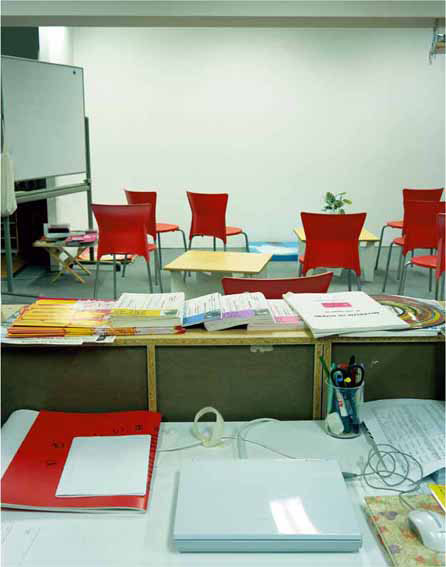
As to prepare the Work Space series for Other Possible Worlds in NGBK, I had to update the info of the art spaces that I visited for the project 3 years ago and re-read the original text. The one provided by Roger McDonald of AIT also includes a written reply to my questions drafted for the interview. It still reads well and I share it here.

What’s the name of your organization?
Arts Initiative Tokyo or AIT for short.

Where, when and who founded it?
Began MAD, our school in 2001. Became a registered non profit organization in 2002.

What’s the story behind this name?
It says most succinctly what we do and what we aim to do – create initiatives related to art from Tokyo.

How many people were involved when it began and how many now? Who were/are they?
Six people at the start. Three of us are full time. Four work in other positions and plug in when necessary.

How did it start? What was the social/cultural background then?
Talking over beers in bars about what we thought Tokyo lacked/ needed/could do with improving. Many of us had spent time outside Japan studying. We had all returned to live and work. We began by spending about six months talking to various people, doing research and field work on what the Tokyo art situation was like – mapping it out to see what may be needed and how things could be different/ better.

Did the location of your first space matter? Did you ever move? Why/ why not?
For the first 2 years we ‘squatted’ the library/ meeting room of Nanjo & Associates curatorial offices. We moved into our current premises in 2004. We have remained in the Daikanyama area of Tokyo because it is near Shibuya (a major train hub), has a certain village feel about it and seems attractive to the people who sign up for our courses.

What was the management model in the beginning? Any change in the structure of organization? Why/ why not? Are you steering it to an unprecedented model, or you do have some examples as reference?
Director, two Deputy Directors. Practically speaking we each do multiple things. Each project may be led by one member with assistance from the others. Finances and general strategy is co-ordinated by the Director. Its rather shared and equal. Being small, we have tried to keep things compact, sustainable and tight.

What kind of activities did you do in early years and what’s the change and development? How do you see the relationship between your change and the development of local art scene?
The first initiative was MAD, our school. It is independent of academic institutions and works more like evening classes. We offer Japan’s first curatorial studies courses, as well as courses on reading texts in English, contemporary art history and artists presentation skills – all aspects which art schools seem rather weak at. We began the artist in residence in 2003 because Tokyo lacked a proper residency – the city or state was not interested. Our efforts have hopefully encouraged others to follow suit, and now the City of Tokyo operates a residency. We continue to curate experimental exhibitions and events, and organize artists and curators talks. If someone interesting is passing through Tokyo we can organize something fast, without bureaucratic paper work. There is a large, eager constituency for contemporary art in Tokyo and beyond, which we try to tap into and expand. We are interested in creating discursive, layered spaces, rather than privilege exhibition or display.

How do you position your institution in relation with other establishments, organizations and artists in the hierarchy (if any) of the art world?
We try to read and map the situation, to see what could be improved and maintain an independent attitude. Being an independent school offers a sense of difference to being a gallery or museum or art university. We seem to attract many people who want to learn more about art, but who are not students. Working people, house-wives, businessmen and students seem to be able to connect with what we offer and do – perhaps because we are not a ‘traditional’ framework like a commercial gallery or museum. This sense of broad appeal and molding a space wherein people can come together to think and discuss art and related issues at length is important to us.

What’s the focus of your programme? Do you specialize in certain area of art & artists? Are you also engaged in international/regional exchange? Could you elaborate your ideas on this issue?
Our main initiative is running a school, and all this entails. We invite speakers from different fields to come and speak, we put together curriculums and try to create a comfortable space to discuss issues related to art, society, politics, religion. We do have a particular penchant for thinking about contemporary art as one activity within the wider social field, so we are interested in relations between what artists do and the various ways we can understand this. We try to maintain an international outlook – all our public mailings are bi-lingual and talks are consecutively translated. Many foreign curators and artists come to visit us. But this is time-consuming and often expensive. I notice that in recent years the subject of education or learning and contemporary art has received a fair bit of attention. I like to think that since 2001 we have tried to practice and initiate another way that an arts organization can operate. We are interested in nurturing audiences for contemporary art in Japan, and so are very open to offering courses which take an introductory or beginner’s level approach, right up to post-graduate level sessions on art theory or aesthetics. We are also interested in thinking how larger theoretical concerns such as ‘post-colonialism’ or ‘globalisation’ can be thought through in Japan – to connect them to local histories and issues rather than simply being exotic concepts which are expounded in big exhibitions in Europe. I suppose you can say that we are constantly involved in processes of translation and mis-understanding. It seems that this kind of experience is something that cannot be so easily generated in commercial galleries or even museum shows which tend to be about explicating clear narratives and understandings. I hope that what MAD enables is some space for dissonance and un-learning to occur – to be able to question what canons have passed down, to think imaginatively.

Where is your funding from? Is it related, or does it affect your programme? How do you see commercial sponsorship? How do you maintain your independence in programming?
Amost all of our funding is self generated – we developed a business model from the beginning and this has continued. The school generates most of our annual income. The courses are fee paying and of different duration. The artist in residency generates income through management fees from various foreign arts partners, like IASPIS, FRAME and Asialink. Project funding is generated from individual grant applications to Japanese Foundations. In these cases, the content of projects may be broadly tuned into the particular directions of Foundations or Companies. But basically we are rather independent in terms of funding. We must generate our salaries, running costs, rent etc by ourselves.

Is there any legacy in your organization?
We are in our eighth year. I hope that some legacy may begin to emerge after ten years or so.

What are the weak point and the strength of your organizations?
Weaknesses – we tend to be rather ‘invisible’, because much of what we do involves discursive events rather than exhibitions. Strengths – Our ‘invisibility’ enables us to remain focused on issues and nurture longer durational projects or interests.

Has it ever have any crisis? How did it get over it?
When visitors enter our space without taking their shoes off – we ask them politely to do so and all is well.

What’s your plan/idea/dream for the next five years (shorter or longer)?
To develop new layers to what we have built up so far – to create a more complex and self generating situation which continues to build on what we have achieved. Small steps, to slowly generate new potentials – e.g. AIT book publications series, work with artists to realize limited editions, create a small exhibition area in our classroom space etc.

Thursday, November 12, 2009

Podcast with Wolfgang Zinggl


Wolfgang Zinggl is a Member of Parliament of Austria and the spokenperson for arts and cultural policy for the Green Party, but before these (in his own words) an active member of socially engaging artist group WochenKlausur that he founded in 1993 and exhibited in Venice Biennale in 1999. Stepping on both tracks of art and politics, Zinggl talks about how he has become politician from a State Curator and an art critic. Recorded on August 19, 2009, 39 min., English. Listen

Tuesday, August 25, 2009

Podcast with Stephan Lugbauer

Saprophyt/ Installation view Jenni Tischer, Alle eure Farben, June 2009 Saprophyt is a very new art space founded by two young Austrian artists, Barbara Kapusta and Stephan Lugbauer in Vienna in August, 2008. Someone says artist-run initiatives are like generational phenomenon and almost all ambitious artists in the beginning of their career would similarly make their own space. Stephan Lugbauer talks about his ideas and thoughts about Saprophyt, named after a kind of fungi which live on dead matters. 51 min, English. Listen

Friday, July 17, 2009

Podcast with Davide Quadrio

Davide Quadrio, also known as Dadou in China, speaks about BizArt, an independent art organization that he co-founded eleven years ago, and his experience in China. It's an interview made on March 13, 2008 when the commercial development of Chinese art was still burning hot. English, 50 min. Listen

Tuesday, May 12, 2009

Podcast with Zoe Butt

Slowly catching up with all those interviews that I did last year, I upload here the one with Zoe Butt, Director of International Programs at Long March Project conducted on March 14, 2008. She talks about generally Long March Project and her rather new position back then. Possible changes of Long March Project are also mentioned in it, now somehow as a note to the recent closure of its two of three galleries. English, 52 min. Zoe also co-curated Time Ligaments, opening this Sat, May 16, 2009 at 10 Chancery Lane Gallery Art Projects in Chai Wan. Listen

Thursday, April 9, 2009

Rich. Streitmatter-Tran

International Curators’ Talk Series
Public Lecture -
“Curatorial engagements in the Mekong Subregion of the Southeast Asia”
by Rich. Streitmatter-Tran

Date: Friday 17 April, 2009
Time: 7:30pm
Venue: Room C01, Hong Kong Arts Development Council, 14/F, East Warwick
House, Taikoo Place, 979 King's Road, Hong Kong.
Seats: Limited Seats: 60

Para/Site Art Space is honored to present a Public Lecture by Rich.
Streitmatter-Tran, Co-curator of Asia Pacific Triennial (APT6).

Streitmatter-Tran is going to introduce some of the conditions in the
Mekong sub region that affect contemporary arts practices with a particular
stress on the curator-artist relationship. He will draw upon his previous
research with the Mediating the Mekong Project, which is a connection to
his current curatorial research with the development of a Mekong-based
platform for the upcoming Asia Pacific Triennale. He will attempt to
provide some insight from the perspective of an artist working with
curators and what an artist might consider a “good curator” as opposed
to an art critic, institution, and the public at large.

Rich. Streitmatter-Tran is an artist living and working in Ho Chi Minh
City, Vietnam. He received his degree in the Studio for Interrelated Media
(SIM) at the Massachusetts College of Art in Boston. His work, solo and
collaborative, has been exhibited in several cities in the United States,
Europe and Asia including the 52nd Venice Biennale, 2007 Shenzhen and Hong
Kong Bi-City Biennale of Urbanism and Architecture, the Singapore Biennale
2006 and 2008, the 2004 Gwangju Biennale, 2005 Pocheon Asian Art Festival,
ZKM in Karlsruhe, Germany, Asia Art Now at Arario Beijing, the Hugh Lane
Gallery in Dublin, Kandada Art Space in Tokyo, the Blue Space Gallery in Ho
Chi Minh City, the Asiatopia Performance Art Festival in Bangkok, Art Tech
Media 06 in Barcelona. He is an Asia Pacific correspondent for the
Madrid-based arts magazine Art.Es and Ho Chi Minh City editor for
Contemporary. He was awarded the 2005 Martell Contemporary Asian Art
Research Grant in 2005 with the Asia Art Archive in Hong Kong for his
year-long research project, Mediating the Mekong. He was Teaching Fellow at
Harvard University (2000-2004), conducted media arts research at the MIT
Media Lab (2000), Visiting Lecturer at the Ho Chi Minh Fine Arts University
in 2003. Currently he is a lecturer at RMIT University Vietnam and serves
as academic advisor to MOCA China and the co-curator of Asia Pacific
Triennial (APT6).

Para/Site Art Space
G/F, 4 Po Yan Street, Sheung Wan Hong Kong
Hours: Wed-Sun; 12-7
Tel: (+852) 25174620 │Fax: (+852) 25176850
info@para-site.org.hk
www.para-site.org.hk


藝術講座:國際策展人講座系列
公開講座
「東南亞湄公河屬區的策展空間」﹣RICH.
STREITMATTER-TRAN主講

日期:二零零九年四月十七日 (星期五)
時間:下午七時半
地點:香港英皇道979號太古坊和域大廈東翼14樓香港藝術發展局C01室
座位:60

Para/Site
藝術空間將於四月十七日,於香港藝術發展局舉辦公開講座;講者為Asia
Pacific Triennial (APT6) 聯合策展人﹣Rich. Streitmatter-Tran。

Rich.
Streitmatter-Tran將為大家介紹一些湄公河屬區影響當地的當代藝術發展狀況,
尤以策展人跟藝術家之間的關係。講者將講述其早前的研究計劃﹣「Mediating
the Mekong Project 」。這研究計劃跟講者現時為來屆Asia
Pacific Triennale
(APT6)而準備的策展研究計劃相連,是以湄公河屬區為發展平台的策展研究。
講者會嘗試以藝術家角度,表達藝術家跟策展人合作的一些觀點,
並對藝術家可擔當優秀策展人這舉措提供跟藝評、機構及公眾以外的看法。

Streitmatter-Tran現於越南胡志明市工作及居住,講者於波士頓Massachusetts
College of Art 的 Studio for Interrelated Media (SIM)
完成學士課程.。講者的個人及合作作品於不同城市如美國、歐洲及亞洲包括第五十二屆威尼斯雙年展、
二○○七年香港﹣深圳城市/建築雙年展、二○○六及二○○八年的新加坡雙年展、二○○四韓國光州雙年展、
二○○五年Pocheon Asian Art
Festival、德國卡爾斯魯厄的ZKM、Arario Beijing 的
Asia Art Now、都柏林的Hugh Lane Gallery、東京的Kandada Art
Space、
胡志明市的 Blue Space Gallery、曼谷的Asiatopia Performance
Art Festival、巴塞隆那的 Art Tech Media 06等展覽。Rich.
Streitmatter-Tran是西班牙馬德里藝術雜誌Art.Es的亞太區的特派員,
Contemporary的胡志明市編輯。講者與亞洲藝術文獻庫的研究計劃「Mediating the
Mekong」於二○○五年獲得Martell Contemporary
Asian Art Research Grant。講者是二○○○至二○○四年哈佛大學MIT Media Lab
(2000)的媒體藝術研究教學助理,二○○三年Ho Chi Minh Fine Arts
University的客席講師。講者現於RMIT University Vietnam任職講師、MOCA
China的學術顧問及Asia Pacific Triennial(APT6) 聯合策展人。

Para/Site 藝術空間
香港上環普仁街四號地下
開放時間:星期三至星期日;下午十二時至七時
電話:(+852) 25174620 │ 傳真:(+852) 25176850
info@para-site.org.hk
www.para-site.org.hk

Friday, April 3, 2009

Michael Lee


(photo by Qinyi Lim)
Singaporean artist Michael Lee Hong-hwee was based in Hong Kong for the last 30 months and has just bidded farewell to his first loft-studio in Fo Tan and moved back to Singapore. He talks about his artistic practice and Hong Kong experience. English, 53 min.
Listen

Tuesday, February 24, 2009

Jens Hoffmann

International Curators’ Talk Series: Public Lecture - Jens Hoffmann

“Curating and Creating” by Jens Hoffmann

Time and Venue: Saturday 28 February, 2009 ; 2:30 pm at Agnes b. CINEMA!, Hong Kong Arts Centre, 2 Harbour Road, Wanchai, Hong Kong. Limited Seats: 190

Wednesday, August 27, 2008

Podcast with Tobias Berger


Tobias Berger talks with Hong Kong art critic Jaspar Lau at the time bidding his farewell to Hong Kong after three and a half year as Executive Director of Para/Site Art Space. From September 2008, Berger will become the Chief Curator of the brand new Nam June Paik Art Center in Seoul. English, 60 min.
Remark: this is the second recording of the interview after a disastrous technical problem of the recorder. However, the technical problem repeated and a ten min-long sound clip was missing in the first quarter of this recording.
Listen

Monday, August 25, 2008

Podcast with Roger McDonald

Roger McDonald, Deputy Director and Co-founder of A.I.T. (Arts Initiative Tokyo), one of very rare curator-initiatives in Asia, talks about the founding of their organization in the context of contemporary art development in Japan. 47min. English
Listen

Tuesday, April 15, 2008

Podcast with Mella Jaarsma


Cemeti Art House co-founder Mella Jaarsma talks about her art space and the art environment in Yogyakarta, Indonesia. It's the first episode of Work Space, a new series of interviews on art spaces in Asia. English. 32 min.
Listen

Monday, March 31, 2008

Finale

Just returned from Tokyo (where I went from Seoul) today and it marked the end my "Asia" tour -- 26 days on the road since the Chinese New Year to nine cities. Some of these cities I only went for the first time, like Yogyakarta and Saigon. I really feel lucky to have taken part in this Open Space project. Just trying to count from memory whom I have met (and had good chat): Mella, Davide, Wimo, Rock, Gentong, Angki, Ade, Reza, Indra, Chiao, Shun-chu, Mia, Yao, Henri, Fang, XuZheng, Cody, Arin, David Teh, Connelly, Tho, Chuong-Da, Marco, Michael, Hyunjin, Jinsuk, Sunjung, Hitomi, Kenji, Emil, Roger, Kai.... should be more than 32. Although travelling was exhausting, it's such a rare opportunity that I couldn't miss. It's intense but I also learnt a lot from them and these places. Big thanks.

Michael and me in a Korean pizza shop in Seoul, photo taken by Cody. Cody is an interesting artist who spent 23 years in America, who I met in his solo show opening in Beijing. Michael is a contributing curator of this year's Busan Biennale. When I met him, he's already several meetings after arrival on the same day.

Wednesday, February 20, 2008

Dadou in Jogia

I had a very nice chat with Davide “Dadou” Quadrio of BizArt before he returned to Shanghai after a meeting with colleagues from Singapore, Manila and here Jogia. They have started a collaboration on a project with young curators in the region. Sometimes I really feel we might progressing in a similar direction as there’re more social/economic exchanges in Asia as in different places there’re drives for development of curatorial practice as Para/Site has implemented its curatorial programme.
It’s almost become a usual topic about the art market boom in Asia and the up-roaring price of contemporary Chinese art recently when you talk to anyone from the art community in Asia. Our conversation is no exception. Of course it also touched the idea of independent art organizations. In China’s context, an “non-profit” art space could also represent artists in art fairs. Somehow Dadou was proud that he didn’t do. Not that he had problem with commercial gallery practice, he’s bothered by the fact that you’re doing it but claiming something else.
By the end of the meeting, there’s also Daphne who once worked in the New Museum in New York but now lives in Shanghai and works with Dadou. Small world it is; she’s also from De Appel and her study here was partly due to Tobias’ advice!

Thursday, January 24, 2008

Podcast with Lee Kit


A chat with Hong Kong artist Lee Kit who has recently completed a one month-residency in Wellington of New Zealand, hosted by the Enjoy Public Art Gallery. Lee talks about his project and experience in Wellington and compares its art scene with that in Hong Kong. Cantonese, 41 min.
Listen
Lee Kit's blog

Wednesday, January 23, 2008

Post-realism


I have met a very interesting artist the other day. He's 張北如(Cheung Pak Yu), truly a great master of crafts. He showed me a few playful works from his pocket, some melon seeds made of clay. It's super realistic. Or, you just thought real even holding them in your hand. The only slight difference would be that you felt them a little bit cooler than room temperature because of the ceramic nature. He said somehow it's not all about realism as he didn't modelled them after some real seeds. It's only the observation of many and he created the unique pieces. It can be most abstract.
It's our luck to have him (living for many many years) in Hong Kong. Perhaps there isn't another He in mainland China.

Sunday, December 23, 2007

Podcast with Sarah Van Ingelgom

Fo Tan is an old industrial area in Hong Kong, recently revived by artists' studios. Sarah Van Ingelgom talks about her Blue Lotus Gallery, the first gallery equipped with a regular exhibition programme in Fo Tan. English, 30 min.
Listen

Thursday, November 22, 2007

Podcast with Vanessa McRae

Vanessa McRae, Exhibitions Manager of the Institute of Modern Art in Brisbane has spent eight weeks in Hong Kong as her AsiaLink residency. She talks about her observation and experience in the Hong Kong arts community.
listen