Showing posts with label artist. Show all posts
Showing posts with label artist. Show all posts
Friday, January 1, 2016


Monday, September 12, 2011
Szeto Keung (1948-2011)
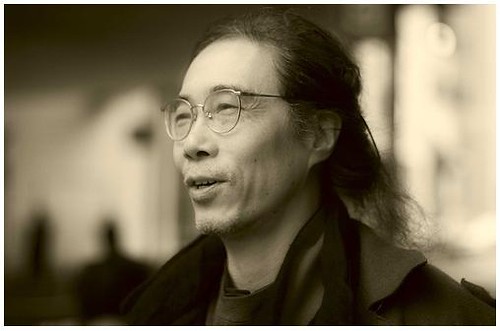
Photo: ©Travis Price
Szeto Keung, a mentor and a good friend passed away last week. One of the most popular figures in the Chinese artist community in New York in the last 30 some years, Szeto entered into the mainstream art world well before Chinese contemporary art was recognized. Represented by OK Harris as an artist for his own merit and not because of his ethnicity, he has been well respected by fellows of his generation and the younger. He was befriended with many Chinese artists and curators from Hong Kong, Taiwan and Mainland China, no matter well-known or unknown, for his very helpful and open-minded character. His studio in Spring Street was a meeting place and point of contacts for friends and acquaintance. Curious in different knowledges and Chinese cultures, Szeto was generous for conversations with elders or youngers.
I first met him in 1996 when he was the artist-in-residence in the Chinese University of Hong Kong where I was doing my MFA. Although he was very famous for his superrealist painting, I was impressed with his knowledge of Barthes and his insight in photography. As a student only, I was feeling so much encouraged by such a conversation in which you were fully respected as a mature artist. It was a brief encounter but impressing. Three years later I got an opportunity to reside in New York for 18 months. It was the time that I could really enjoy his humour and wisdom at the same time. As a walking dictionary for artists in New York City, his presence would always make you feel secure and easy. He could also exchange on many technical issues of art as well. Basically, I learnt how to operate a large format camera from him. I still use the camera that he used before.
With him, many nights in the diner round the corner of his studio where we had unlimited barely-drinkable watery coffee at 50 cents would just become joyful. He would also extend his social network for you, so you can survive many otherwise lonesome moments.
He might not want a label of Hong Kong artist on him but his importance in the Hong Kong contemporary art is unquestionable. He is always a good artist with substance and integrity. He is always missed.
A memorial will be held in the Eric Hotung Studio, Hong Kong Arts Centre on Sunday, September 18 at 7pm.
Thursday, November 12, 2009
Podcast with Wolfgang Zinggl

Wolfgang Zinggl is a Member of Parliament of Austria and the spokenperson for arts and cultural policy for the Green Party, but before these (in his own words) an active member of socially engaging artist group WochenKlausur that he founded in 1993 and exhibited in Venice Biennale in 1999. Stepping on both tracks of art and politics, Zinggl talks about how he has become politician from a State Curator and an art critic. Recorded on August 19, 2009, 39 min., English. Listen
Monday, September 7, 2009
Emil Goh
Just got a sad news from Wendy Gan about Malaysian Chinese artist Emil Goh:
"Emil passed away suddenly on the morning of 7 September 2009 in Seoul. He had a seizure of some kind in the morning. The ambulance was called but his heart had stopped beating by the time the ambulance reached the hospital. His girlfriend was by his side.
This has been a huge shock. He was still young and with no health problems that we knew of. We do not yet know what exactly happened.
I hope you will remember him for the enthusiastic foodie and wonderful artist and designer that he was. He had a keen eye for the mundane but quirky beauty of small things and his vision, his sense of humour and his mind that bubbled over with intellectual curiosity and delight in the world will be sorely missed by all of us."

Our last meal in Seoul when I was there in 2008. Emil sitting behind the Korean bbq.
Friday, April 3, 2009
Michael Lee

(photo by Qinyi Lim)
Singaporean artist Michael Lee Hong-hwee was based in Hong Kong for the last 30 months and has just bidded farewell to his first loft-studio in Fo Tan and moved back to Singapore. He talks about his artistic practice and Hong Kong experience. English, 53 min.
Listen
Tuesday, March 10, 2009
Wednesday, March 4, 2009
Thank You Art

The Day of 39@rt ("thank you art") is a holiday to appreciate, promote, and otherwise positively engage ourselves in contemporary art. It was established by Japanese artist Yoshiaki Kaihatsu in 2000 to foster the appreciation of contemporary art in Japan. Last year it has been celebrated in 157 locations by individuals and institutions in three continents.
Wednesday, November 5, 2008
Good read of Fo Tan
An article by Michael Lee on the Wah Luen Industrial Centre where tens of studios are located.
Tuesday, July 22, 2008
Why are artists poor?
Posted from Decentre book project:
Why are artists poor? is the title of a new book by Hans Abbing. You won't find simple answers in it but Abbing does a nice job of describing the intricacies of the art milieu and the many complicated reasons we keep on keeping on, e.g.:
Table 4.
Aspects Contributing to the Exceptional Nature of the Economy of the Arts
1. The valuation of art products tends to be asymmetric; one group looks up to the high art of the other group, while the latter looks down on the low art of the former. (Chapter 1)
2. In the arts: (1) the economy is denied; (2) it is profitable to be non-commercial; (3) commercial activities are veiled. (Chapter 2)
3. Art and artists have an exceptionally high status. (Chapter 1)
4. Artists overlook or deny their orientation towards rewards. (Chapter 4)
5. Top incomes in the arts are extremely high; higher than in other professions. (Chapter 5)
6. The large majority of artists earn less than other professionals do. Hourly income is low or even negative. In the modern welfare state, this is truly exceptional. (Chapter 5)
7. Despite these low incomes, an unusually high number of youngsters still want to become artists. The arts are extremely attractive. (Chapter 5)
8. Beginning artists face far more uncertainty than the average beginning professionals. (Chapter 5)
9. Money represents a constraint rather than a goal for many artists. (Chapter 4)
10. Artists are (more than others) intrinsically motivated. (Chapter 4)
11. Artists are (more than others) oriented towards non-monetary rewards. (Chapter 5)
12. Artists are (more than others) inclined to taking risks. (Chapter 5)
13. Artists are unusually ill-informed. (Chapter 5)
14. A combination of myths reproduces misinformation about the arts. (Chapter 5)
15. Artists more often come from well-to-do families than other professionals. (This is even more exceptional because usually the parents of ‘poor’ people are also poor.) (Chapter 6)
16. Poverty is built into the arts. Measures to relieve poverty do not work or are counterproductive. (Chapter 6)
17. The arts are characterized by an exceptional high degree of internal subsidization. By using non-artistic income artists make up the losses they incur in the arts. (Chapter 6)
18. The gift sphere in the arts is large; subsidies and donations comprise an unusually large portion of income. (Chapter 2 and 8)
19. Unlike other professions, the arts do not have a protected body of certified knowledge. Anybody can access it. (Chapter 11)
20. Unlike other professions, there is no formal control of numbers in the arts. Anybody can pursue an arts career regardless of their qualifications. (Chapter 11)
21. Many informal barriers exist in the arts. (Chapter 11)
Hans Abbing, WHY ARE ARTISTS POOR? THE EXCEPTIONAL ECONOMY OF THE ARTS (Amsterdam University Press)
ISBN 978-9-0535656-50-5
€ 25,90
http://www.aup.nl/do.php?a=show_visitor … 0535656505
--
Robert Labossiere, Managing Editor, YYZBOOKS
Monday, May 5, 2008
Podcast with Xu Zhen

Tuesday, April 15, 2008
Podcast with Mella Jaarsma

Cemeti Art House co-founder Mella Jaarsma talks about her art space and the art environment in Yogyakarta, Indonesia. It's the first episode of Work Space, a new series of interviews on art spaces in Asia. English. 32 min.
Listen
Thursday, January 24, 2008
Podcast with Lee Kit

A chat with Hong Kong artist Lee Kit who has recently completed a one month-residency in Wellington of New Zealand, hosted by the Enjoy Public Art Gallery. Lee talks about his project and experience in Wellington and compares its art scene with that in Hong Kong. Cantonese, 41 min.
Listen
Lee Kit's blog
Subscribe to:
Posts (Atom)